
First Home or Investment Property? A Smarter Framework for Bay Area Tech Professionals
December 22, 2025
December 22, 2025
You've just closed a Series B round or hit your five-year vesting cliff. Your equity is liquid, your savings are substantial, and everyone around you seems to be talking about real estate. But here's the question that keeps you up at night: Should you buy your dream home in Los Altos Hills, or invest strategically in a rental property in Oakland? The answer isn't obvious, and generic advice won't work for your situation.
As a tech professional earning $200K+ with RSUs, stock options, and complex tax exposure, your real estate decision is fundamentally different from the average Bay Area buyer. Your income volatility, equity compensation structure, and long-term wealth goals demand a personalized framework, not a one-size-fits-all recommendation. This blog walks you through a strategic decision-making process designed specifically for high-net-worth tech professionals. By the end, you'll understand how your financial profile should drive whether your first real estate move should be a primary residence or an investment property.
Before any real estate decision, you need brutal clarity on your actual financial position. RSUs and stock options look impressive on paper, but they're not the same as cash. If you're at a public company like Google or Apple, your vesting schedule, blackout periods, and equity concentration risk directly impact how much capital you can safely deploy into real estate without jeopardizing your financial security.
Consider Sarah, a senior software engineer at a major Bay Area tech firm earning $250K base plus $300K in annual RSUs. She assumed she could afford a $2.5 million home based on gross compensation. However, after accounting for 37% federal income tax on RSUs, 9.3% California state tax, Medicare tax, and her desire to diversify away from tech stock, her true available capital was significantly lower. By modeling her actual after-tax cash flow and maintaining a six-month emergency fund, we determined a $1.8 million purchase was smarter, freeing capital for a second investment property instead. Had she followed the "30% rule" blindly, she would have overleveraged herself.
Start here: Calculate your after-tax income from salary plus vested RSUs. Subtract taxes, existing obligations, and a safety buffer. Only then do you know your true liquidity for a down payment and ongoing carrying costs.
Tech careers are rewarding but volatile. A startup acquisition, layoff, or pivot can shift your financial landscape within months. Your real estate strategy must account for this reality. If you're at a growth-stage startup with concentrated equity, your income could double or disappear within three years. If you're at an established company, you have more predictability but also potentially lower upside.
This timeline matters enormously for the primary residence versus investment property decision. A primary residence locks you into a location and a mortgage payment tied to your current income assumptions. An investment property, by contrast, relies on market rent and tenant cash flow, which is more forgiving of personal career transitions.
Marcus, a product manager at a Series B startup, was attracted to buying a $1.9 million home in Palo Alto. However, we modeled three scenarios: successful exit (high income continues), acquisition into a large tech firm (moderate income change), and layoff (income drops 60%). In the third scenario, carrying a primary residence mortgage plus other obligations would be stressful. Instead, we recommended a more modest primary residence at $1.2 million and a duplex investment in San Jose as his second move. This strategy preserved flexibility while building wealth through real estate leverage.
Your RSUs and stock options carry embedded tax obligations that most real estate advisors don't understand. When you sell RSUs to fund a home purchase, you're triggering immediate income tax. If you're holding concentrated company stock, selling creates capital gains tax. These tax bills directly reduce your down payment capital and should be modeled carefully.
Beyond the purchase itself, owning investment property offers tax advantages that a primary residence does not. Mortgage interest deduction, property depreciation, maintenance deductions, and depreciation recapture are powerful tools for tech professionals with high ordinary income. A rental property can shelter taxable gains from RSU vesting or a bonus through legitimate deductions.
Consider James, a data scientist earning $220K base plus $200K annual RSUs. He planned to buy a home for $2.1 million and thought he was done with real estate. However, his tax advisor and real estate strategist collaborated to show that acquiring a two-unit investment property in East Bay would allow him to depreciate the building, deduct mortgage interest, and offset 30-40% of his RSU income through real estate losses. Over ten years, this strategy converted what would have been tax-inefficient income into real estate equity while reducing his annual tax bill by $15K-25K.
The framework is simple: Model both scenarios (primary residence only versus primary residence plus investment property) with your tax advisor. Include the actual tax cost of funding each purchase. Then compare net wealth accumulation after taxes over a five to ten-year horizon.
Zillow Research consistently shows that in high-cost Bay Area markets, the rent-to-price ratio favors rental over purchasing for some properties, while primary residences are more favorable in others. As a tech professional, you have the capital to exploit these inefficiencies strategically.
Some neighborhoods, like parts of Oakland and Hayward, offer rental yields of 3-4% gross, which after taxes and vacancy can provide solid cash-on-cash returns. Other neighborhoods, like central Palo Alto or Mountain View, have rent-to-price ratios below 2%, making them poor investment plays but reasonable primary residences if you value being in those communities.
The framework is this: If you're buying a primary residence, choose based on lifestyle and long-term satisfaction, not investment return. If you're buying an investment property, demand a rent-to-price ratio that supports positive cash flow and at least 5% annualized appreciation potential based on historical trends. Never sacrifice a good personal fit for a marginally better investment.
Elena, a VP of Product at a growth-stage startup, loved the Sunnyvale neighborhood where she worked. Buying there as a primary residence made lifestyle sense, but the rent-to-price ratio was 1.8%, terrible for investment. Our recommendation: Buy a modest primary residence in Sunnyvale ($1.6 million) and deploy a second purchase to a cashflow-positive property in San Jose, where the ratio supported 3.5% gross yield. This dual strategy balanced her personal preferences with wealth-building efficiency.
Your first real estate purchase sets the tone for leverage, equity buildup, and future financing. The question isn't just what to buy, but in what order to buy it. For some tech professionals, a primary residence first makes sense. For others, a strategic investment property first creates more flexibility later.
If you're early in your tenure at a stable large company and your career trajectory is predictable, buying a primary residence first anchors your lifestyle while you build equity. Once you've owned for three to five years, you have meaningful home equity to leverage for a second investment purchase using a HELOC or cash-out refinance.
Alternatively, if you're at a pre-liquidity event startup or early in your wealth accumulation phase, an investment property might come first. It can cash-flow modestly, build equity through mortgage paydown and appreciation, and provide more flexibility if your personal situation changes. You can always buy a primary residence later when your situation stabilizes.
David, a startup founder, faced this decision. He had $800K liquid after a secondary sale, no primary residence, and significant remaining equity in his company. We modeled two paths: (A) Buy a $1.2M primary residence, then an investment property in two years once home equity and cash flow rebuilt; (B) Buy a dual-unit investment property now, build cash flow and tax deductions, then upgrade to a primary residence in five years using accumulated equity. Path B won because it aligned with his high growth trajectory and tax situation. Today, his investment properties have appreciated 35%, generated tax-sheltered cash flow, and given him the capital to buy his dream home without stretching.
Your first real estate move as a high-net-worth tech professional isn't just about finding a property. It's about aligning your purchase strategy with your actual financial profile, tax situation, career volatility, and long-term goals. The framework outlined here transforms a confusing decision into a deliberate one: Map your true liquidity, sequence your purchases strategically, model tax efficiency with precision, and demand favorable economics from any investment property.
The tech professionals who build the most wealth through real estate aren't the ones who follow market hype or generic advice. They're the ones who personalize their strategy to their unique circumstances. Whether your next move is a primary residence, an investment property, or a combination of both, it should be based on data about your situation, not assumptions about the market. The stakes are too high, and your financial profile too complex, to guess.

June 18, 2026
The Real Cost of Waiting: How Delaying Your Home Purchase Affects Your Wealth

June 10, 2026
Is It Better to Buy a Rental Property or a Primary Home First in the Bay Area?

June 5, 2026
Santa Clara vs Sunnyvale vs San Jose: Which City Gives You the Most for Your Budget in 2026?

May 27, 2026
The Hidden Biases That Affect Home Buying Decisions

May 20, 2026
Stock Market vs Real Estate Investment: Where Should Tech Professionals Put Their Money in 2026?

May 11, 2026
New Construction vs Old Homes in California: What’s Better?

May 8, 2026
Down Payment Scenarios when Buying Home
May 1, 2026
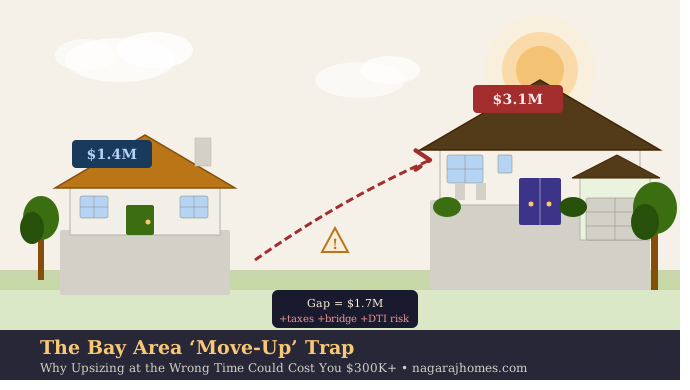
The Bay Area 'Move-Up' Trap: Why Upsizing at the Wrong Time Could Cost You $300K+

April 28, 2026
The H-1B Homebuyer's Playbook: How Visa Status Affects Your Bay Area Mortgage
Whether it's finding you a home with everything on your checklist or helping you get ready to move, he's got you covered - advertising, financing, inspection, and closing assistance, he will handle it all from start to finish. Nagaraj can even provide tips and tricks on staging and minor home improvements to help sell your home fast. Give him a call or stop by, Nagaraj is right in the neighborhood!