
Why Buying Your First Home in the Bay Area Is Harder for High-Income Tech Professionals (And How to Do It Right)
December 30, 2025
December 30, 2025
You earn $300,000 to $500,000 annually. Your tech company granted you RSUs worth six figures. Bonuses flow regularly. By any traditional metric, you should be able to buy a home in the Bay Area without stress. Yet here you are, facing a brutal reality: homes in desirable neighborhoods start at $2 million, your stock compensation is volatile, and mortgage lenders view variable income with skepticism. The Bay Area housing market doesn't care about your salary on paper. It cares about what you can prove, qualify for, and afford after taxes. High income alone is not enough. You need a strategic approach that accounts for your unique financial profile. This blog explains why the conventional home buying process fails high-net-worth tech professionals and reveals the tailored strategies that actually work.
Earning a six-figure salary sounds like a ticket to homeownership, but the Bay Area market tells a different story. According to Zillow Research data, the median home price in San Francisco exceeds $1.4 million, while Silicon Valley neighborhoods command $2 million to $4 million for entry-level properties. More critically, your income structure creates friction. Traditional lenders rely on W-2 income and verified bonuses. Tech professionals typically earn through RSUs, which vest over four years, stock options with uncertain valuations, and performance bonuses tied to company outcomes. One client, a senior engineer at a major tech firm earning $400,000 total compensation, had only $150,000 in documented W-2 income. Banks flagged his RSUs as "speculative." This gap between perceived wealth and lendable income is the first barrier. Additionally, California's tax burden consumes 13.3% of high earners' income at state level alone, reducing actual cash flow for mortgage qualification. A $500,000 annual earner nets roughly $320,000 after federal, state, and FICA taxes. Generic real estate advice ignores these realities. You need advisors who understand your compensation structure and can position your financial profile strategically with lenders.
Your wealth is not linear. RSUs vest quarterly or annually. Stock options exercise at specific windows. Bonus timing varies by fiscal year. This volatility confuses traditional mortgage underwriting, yet it is manageable with proper planning. The key is documentation and tax positioning. When you file taxes, you report all income sources on your 1040. Smart advisors work backward from tax returns to identify the strongest lending narrative. One data scientist we advised had $350,000 in total comp but $180,000 in documented income due to vesting schedules. By timing a home purchase for Q2, after vesting and bonus payouts, we positioned her cash flow to justify a $1.2 million mortgage. The strategy required coordinating with her tax accountant and financial advisor months in advance. Additionally, understanding capital gains versus ordinary income matters. If you exercised options at a profit, that gain is taxable. Planning the timing of exercises and sales around home purchases can reduce tax liability and improve your cash flow narrative to lenders. Bay Area tech professionals often treat stock decisions in isolation. Strategic advisors integrate real estate, tax, and wealth planning into one coherent approach. This coordination typically saves clients $40,000 to $150,000 in taxes while strengthening their mortgage application.
Bay Area real estate moves at hyperspeed. Homes in hot neighborhoods like Palo Alto, Mountain View, Los Altos, and San Francisco's prime zip codes receive multiple offers within 48 hours of listing. Zillow Research confirms that inventory is constrained while competition is fierce. High-income professionals often lose bidding wars because they approach buying reactively, not strategically. Winning requires three layers: financial readiness, market intelligence, and negotiation power. First, pre-approval must be airtight. Not a standard pre-qual, but lender-verified proof that your compensation story is compelling and documentable. Generic lenders will slow you down. Specialized lenders familiar with tech compensation close faster. Second, you need deep market data. Which neighborhoods are appreciating fastest? Which have family-friendly schools and tech company proximity? A product manager we guided wanted to buy in Sunnyvale but didn't realize that adjacent Cupertino has higher appreciation and better schools. The shift saved her $300,000 in entry price while improving long-term value. Third, you need negotiation leverage. In multiple-offer scenarios, cash strength, timeline clarity, and inspection flexibility matter as much as price. Strategic advisors help you position offers to win. Emotional buying costs money. Data-driven buying wins homes.
Many high-income tech professionals buy a primary home at $1.5 million to $3 million, then realize they have additional capital to deploy. Real estate investment is a proven wealth diversification strategy, especially for tech professionals with concentrated equity risk in company stock. Buying a second property, whether rental income or appreciation upside, requires different analysis than primary residence buying. Rental properties need cash flow underwriting. A $1.2 million condo near Google's Mountain View campus might rent for $4,500 monthly, generating 4.5% gross yield before expenses. Is that aligned with your wealth goals? Investment properties also have different tax implications. Mortgage interest is deductible, depreciation shelters income, and capital gains treatment differs from personal residence sales. One founder we advised bought his primary home for $2.5 million, then invested $1.8 million in two rental properties near major tech campuses. The portfolio generates $12,000 monthly cash flow and shelter approximately $65,000 annually in taxable income through depreciation. Over 10 years, real estate appreciation plus tax benefits likely exceed his stock option gains after taxes. The insight: real estate is not just a place to live. For high-net-worth tech professionals, it is a strategic financial instrument. Advisors who understand both real estate and tech wealth strategies position you for generational wealth building.
Buying a home is a single transaction. Building wealth through real estate is a 10 to 30-year strategy. High-income tech professionals benefit from thinking in phases. Phase one is primary residence acquisition, ideally timed when your documentation is strongest and market conditions favor buyers. Phase two, typically three to five years later, involves evaluating additional investment properties or geographic diversification if your career or life circumstances change. Phase three, after 10 years, is the portfolio optimization phase, where you rebalance holdings, consider 1031 exchanges for higher-return properties, and plan for long-term wealth transfer. One executive we advised had a 20-year plan. Year one: purchase $2 million primary home in Palo Alto. Years two through five: acquire two rental properties totaling $2.5 million near Stanford. Years six through ten: evaluate move-up primary residence if family expanded. Years 11 to 20: optimize portfolio through exchanges, refinances, and potential new markets outside Bay Area. This structured approach, reviewed annually and adjusted for career, family, and market changes, reduced his decision anxiety and kept him aligned with long-term goals. Strategic advisors help you articulate your long-term vision, then reverse-engineer the steps needed today. This clarity turns overwhelming complexity into manageable milestones.
Buying a first home as a high-net-worth tech professional in the Bay Area is genuinely complex. High income does not simplify the process because lenders, market dynamics, and tax realities operate by different rules than salary-based earnings. The traditional homebuying playbook fails you because it ignores your unique financial structure. Success requires integrated planning: positioning your stock compensation strategically to lenders, timing purchases around vesting and cash flow peaks, deploying market intelligence to win competitive bidding, and viewing real estate as part of a broader wealth diversification strategy. The professionals who thrive are those who treat real estate not as an isolated purchase but as a cornerstone of intentional financial planning. You have built incredible wealth in tech. Real estate should amplify that success, not create friction. The path forward is clarity, strategy, and advisors who speak your language.

June 18, 2026
The Real Cost of Waiting: How Delaying Your Home Purchase Affects Your Wealth

June 10, 2026
Is It Better to Buy a Rental Property or a Primary Home First in the Bay Area?

June 5, 2026
Santa Clara vs Sunnyvale vs San Jose: Which City Gives You the Most for Your Budget in 2026?

May 27, 2026
The Hidden Biases That Affect Home Buying Decisions

May 20, 2026
Stock Market vs Real Estate Investment: Where Should Tech Professionals Put Their Money in 2026?

May 11, 2026
New Construction vs Old Homes in California: What’s Better?

May 8, 2026
Down Payment Scenarios when Buying Home
May 1, 2026
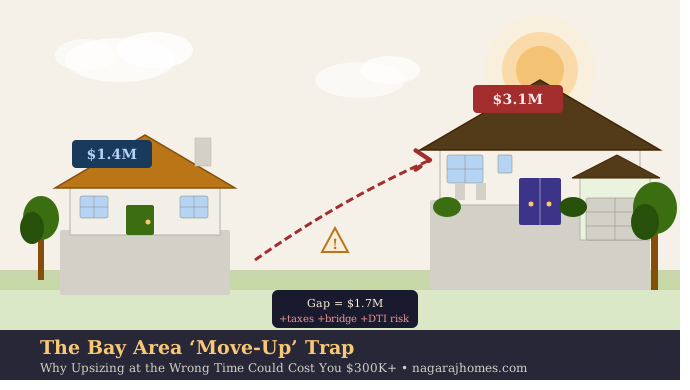
The Bay Area 'Move-Up' Trap: Why Upsizing at the Wrong Time Could Cost You $300K+

April 28, 2026
The H-1B Homebuyer's Playbook: How Visa Status Affects Your Bay Area Mortgage
Whether it's finding you a home with everything on your checklist or helping you get ready to move, he's got you covered - advertising, financing, inspection, and closing assistance, he will handle it all from start to finish. Nagaraj can even provide tips and tricks on staging and minor home improvements to help sell your home fast. Give him a call or stop by, Nagaraj is right in the neighborhood!