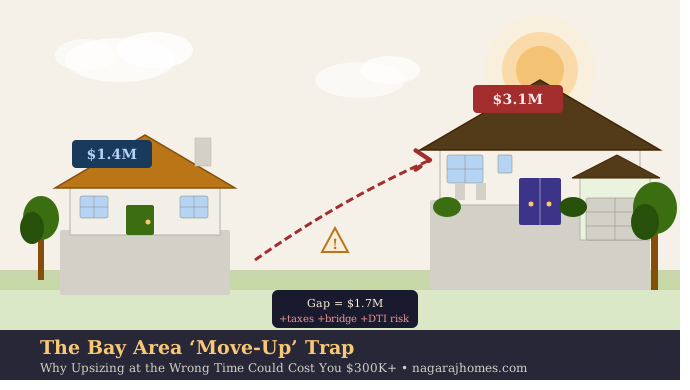
The Bay Area 'Move-Up' Trap: Why Upsizing at the Wrong Time Could Cost You $300K+
May 1, 2026
May 1, 2026
After years of watching your home appreciate and your family grow out of your starter property, the move-up purchase feels like a natural, overdue step. But in the Bay Area, the move-up transaction is one of the most financially complex real estate decisions a homeowner can make — and the stakes are far higher than in a typical market. A wrong sequence of events, a mistimed sale, or an underestimated bridge scenario can easily cost $200,000 to $300,000 in lost equity, tax exposure, or unnecessary carrying costs.
This guide is for Bay Area homeowners who have built equity in a first property and are now evaluating the next step: whether to sell first, buy first, or execute both simultaneously — and how to structure the move in a way that protects their financial position.
In most U.S. markets, the move-up buyer faces a relatively predictable challenge: sell the existing home, use the proceeds as a down payment, and close on the new property. The Bay Area turns this logic on its head in several critical ways.
First, the gap between starter homes and move-up homes is enormous. A 3-bedroom home in Sunnyvale that a buyer purchased for $1.3M five years ago might now be worth $1.8M — but the 4-bedroom, 2,200 sq ft home they want in Cupertino or West San Jose is priced at $2.8M to $3.2M. The equity from the first home often covers a meaningful down payment, but the mortgage on the target property is still a heavy lift, especially after accounting for capital gains taxes on the sale.
Second, the Bay Area's offer-acceptance culture — where sellers strongly prefer clean, non-contingent offers — makes it extremely difficult to make a competitive bid on a new home while still owning the old one. Submitting a home-sale contingency offer in a market where 70% of homes receive multiple bids is often the equivalent of not bidding at all.
The core tension: You cannot safely make a strong offer on a new home if you still own the old one, but you cannot afford to sell the old one without knowing where you are going next. This is the move-up trap.
There are three primary strategies Bay Area move-up buyers use, and each carries distinct financial and practical tradeoffs. Understanding the true cost of each path — not just the obvious one — is essential to making the right choice.
Strategy 1 — Sell First, Then Buy: You list and close on your existing home before making any offers on a new property. The proceeds are in hand, your debt-to-income ratio is clean, and you can make a non-contingent offer. The catch: you need somewhere to live in the gap. In the Bay Area, renting temporarily can cost $4,000 to $7,000 per month for a comparable space, and storage, double moves, and school disruptions add thousands more. A six-month gap between sale and purchase close can cost $25,000 to $50,000 in transition costs alone — before accounting for the emotional and logistical burden.
Strategy 2 — Buy First, Then Sell: You secure a new property before listing the old one. This avoids the transition gap and lets you negotiate from a position of stability. The risk: you are carrying two mortgages simultaneously. In the Bay Area, two mortgage payments — say, $7,500 on the old home and $14,000 on the new one — total over $21,000 per month. Most households cannot sustain this beyond 60 to 90 days. Lenders are also acutely aware of this scenario and will model your DTI on both payments, which can affect your rate or disqualify you entirely without a bridge loan.
Strategy 3 — Bridge Loan + Simultaneous Close: A bridge loan is a short-term financing instrument — typically 6 to 12 months — that allows you to tap the equity in your existing home to fund the down payment on the new one, without requiring the old home to be sold first. This is the most elegant solution for many Bay Area move-up buyers, but it is also the most misunderstood.
Table 1: Move-Up Strategy Comparison
|
Strategy |
Offer Competitiveness |
Transition Cost |
DTI Risk |
Best For |
|
Sell First / Rent |
High (clean offer) |
$25K–$50K (gap costs) |
Low |
Buyers with flexibility & no school urgency |
|
Buy First / Double Carry |
High (non-contingent) |
Very High (two mortgages) |
High |
Short window, high-liquidity buyers |
|
Bridge Loan |
High (equity unlocked) |
Moderate (bridge interest) |
Moderate |
Equity-rich buyers with stable income |
A bridge loan uses the equity in your existing home as collateral to fund the down payment on the new purchase. Most Bay Area bridge lenders will advance up to 80% of your current home's appraised value minus your outstanding mortgage balance. The loan carries a higher interest rate than a conventional mortgage — typically prime plus 1.5% to 2.5% — and is structured to be paid off when the original home sells.
For example: if your Fremont home is worth $1.6M with a $500,000 mortgage balance, a bridge lender might advance up to $780,000 (80% of $1.6M minus $500K), which can serve as a substantial down payment on a $2.8M target home in a better school district.
Where bridge loans fail is when the original home sits on the market longer than expected. A bridge loan is a short-term instrument with a hard maturity date. If your Fremont home does not sell within the bridge term — which can happen in a cooling micro-market or during a poorly timed listing — you face the possibility of the bridge lender calling the loan while you are still carrying the new mortgage. This scenario can force a distressed sale of the original property at a below-market price, wiping out the equity advantage the entire strategy was designed to capture.
Mitigation: before committing to a bridge loan, have your listing agent conduct a rigorous market analysis of your current home's expected days-on-market and sale price probability at various list prices. Do not use a bridge loan if your existing home has deferred maintenance, unusual features that limit buyer pool, or is in a sub-market showing rising inventory.
This is the move-up trap that surprises the most Bay Area sellers. Under current IRS rules, married couples filing jointly can exclude up to $500,000 of capital gains from the sale of a primary residence, provided they have lived in the home for at least two of the past five years. For single filers, the exclusion is $250,000. In most U.S. markets, this exclusion covers the entire gain. In the Bay Area, it often covers less than half of it.
Consider a homeowner who bought a San Jose condo in 2018 for $750,000 and is now selling it for $1.4M. The gross gain is $650,000. After the $500,000 married exclusion, $150,000 of that gain is taxable. At California's combined federal and state capital gains rate for high earners — which can reach 37% to 40% when accounting for the California income tax (which does not distinguish between short and long-term gains) — the tax bill on that $150,000 can exceed $55,000 to $60,000.
This taxable gain directly reduces the usable equity available for the new down payment. Many move-up buyers who model their purchase based on gross sale proceeds are genuinely shocked when their net figure comes in $50,000 to $100,000 lower than expected.
Planning strategy: Engage a CPA with real estate tax experience at least 90 days before listing your current home. Strategies such as timing the close to a lower-income tax year, using deferred capital gains treatment through a 1031 exchange (for investment properties), or coordinating the recognition of capital gains with RSU vest-year income can materially reduce your tax exposure.
In slower markets or with less competitive properties, a home-sale contingency — where your offer to buy the new home is contingent on successfully selling your existing one — can be a legitimate tool. In the Bay Area's most desirable neighborhoods, however, contingency offers are typically non-starters for sellers who have four to eight other non-contingent bids on the table.
There is a middle-ground instrument worth knowing: the bridge-and-sell structure combined with a kick-out clause. In this arrangement, a seller may accept a contingent offer but retains the right to continue marketing the property. If another non-contingent offer arrives, the original contingent buyer is given 72 to 96 hours to remove the contingency or forfeit the deal. This structure is more common in mid-tier Bay Area sub-markets like Milpitas, North San Jose, and parts of the East Bay where seller leverage is slightly lower.
The practical guidance: before submitting any offer strategy, your agent should probe the listing situation carefully — how many offers are expected, what the seller's timeline is, and whether the seller is also a move-up buyer who may actually prefer a slightly longer close. In roughly 20% to 25% of cases, a highly motivated seller will prefer a well-structured contingent offer from a serious buyer over a rushed non-contingent offer from a marginally qualified one.
One frequently underweighted factor in Bay Area move-up decisions is school enrollment timing. Many families are motivated to upsize specifically to access a better school district — but California public school enrollment windows are narrow and unforgiving. Missing a kindergarten or middle school enrollment deadline can mean a one-year wait, which in turn drives families to rush into purchase decisions on a compressed timeline.
A compressed purchase timeline — driven by school deadlines rather than market conditions — is exactly the scenario where buyers make costly mistakes. They overbid on emotionally charged properties to hit an enrollment window, take unfavorable bridge terms because there is no time to shop lenders, or skip critical home inspection steps to accelerate the timeline.
The best move-up buyers in top school district corridors like Cupertino, Los Altos, and Saratoga start the process 12 to 18 months before the enrollment deadline, build a financial model that accounts for all three move-up strategies, and establish pre-approval with a bridge-capable lender well before any listings hit the market.
What is a bridge loan and how does it work in the Bay Area?
A bridge loan is short-term financing — typically 6 to 12 months — that uses the equity in your existing home to fund a down payment on a new property before the old one sells. Bay Area lenders typically advance up to 80% of your current home's appraised value minus your outstanding mortgage. Interest rates are higher than conventional mortgages, and the loan is repaid when your old home closes.
Should I sell before buying in the Bay Area?
It depends on your liquidity, risk tolerance, and family logistics. Selling first gives you a clean financial position and a competitive non-contingent offer, but creates a transition gap that can cost $25,000 to $50,000 or more. Buying first with a bridge loan avoids the gap but requires strong income and a high-confidence sale of your existing home. There is no universal right answer — the correct strategy is unique to your financial profile.
Can I avoid capital gains tax when selling my Bay Area home?
Married couples can exclude up to $500,000 of capital gains on a primary residence sale, and single filers can exclude $250,000, provided the two-year residency requirement is met. However, because Bay Area appreciation often exceeds these thresholds, many sellers owe taxes on the gain above the exclusion. A real estate-focused CPA can help you minimize exposure through timing strategies.
How do I make a competitive offer while still owning my current home?
The most effective approach in the Bay Area is to secure a bridge loan that allows you to access your current home's equity for a down payment, enabling a non-contingent offer on the new property. Alternatively, selling and renting short-term puts you in the strongest financial position. A contingency offer is generally only viable in less competitive sub-markets.
What is a kick-out clause in a real estate offer?
A kick-out clause allows a seller to accept a contingent offer while retaining the right to continue marketing the property. If a competing non-contingent offer arrives, the original buyer is given a short window — usually 72 to 96 hours — to remove their contingency or step aside. This structure gives move-up buyers a path into deals in moderate-competition scenarios.
How long does a typical Bay Area move-up transaction take?
A well-planned move-up transaction — including preparing the existing home for sale, securing bridge financing, making an offer, and closing — typically takes three to six months from start to finish. Families motivated by school enrollment deadlines should begin planning 12 to 18 months in advance to avoid timeline-driven financial mistakes.

August 19, 2026
How Job Changes Affect Your Mortgage Approval

August 12, 2026
How Tech Layoffs Are Changing Home Buying Decisions in 2026

August 5, 2026
How Much Down Payment Do You Really Need to Buy a Home in Silicon Valley?

July 29, 2026
Bay Area Condo vs Single-Family Home: Which Is the Smarter Buy in 2026?

July 22, 2026
How to Compete Against Cash Buyers in Silicon Valley: A Strategy Guide for Financed Buyers

July 16, 2026
Selling Your Silicon Valley Home in 2026

July 9, 2026
How California's Dream For All Program Can Help You Buy a Home in the Bay Area in 2026

July 1, 2026
Rate Lock vs. Float: How Bay Area Buyers Can Win in a Volatile Mortgage Market

June 24, 2026
How H-1B and Green Card Holders Can Buy a Home in the Bay Area (2026 Guide)
Whether it's finding you a home with everything on your checklist or helping you get ready to move, he's got you covered - advertising, financing, inspection, and closing assistance, he will handle it all from start to finish. Nagaraj can even provide tips and tricks on staging and minor home improvements to help sell your home fast. Give him a call or stop by, Nagaraj is right in the neighborhood!